Cloudflare VPN gateway: what it is, how it works, and when to use it
A clear guide to Cloudflare VPN Gateway, its features, use cases, and how it compares to alternatives.
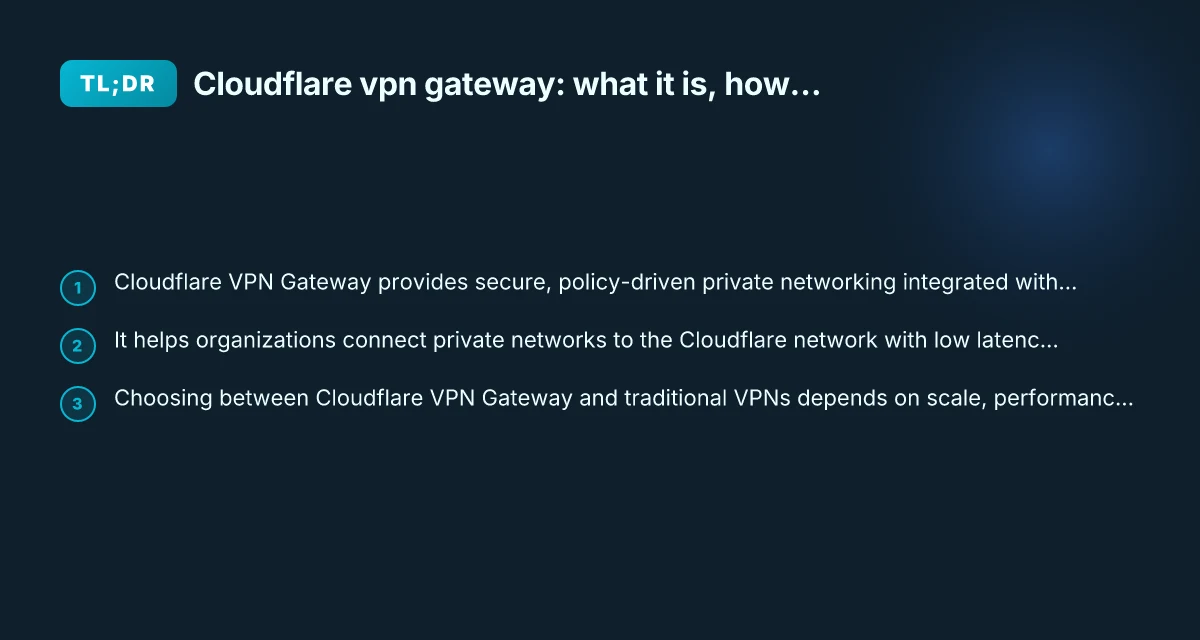
The Cloudflare VPN Gateway is a service that helps organizations securely connect their private networks to Cloudflare’s global edge, enabling private access to apps, data centers, and cloud resources without exposing those resources to the public internet. It’s built to complement Cloudflare’s broader security and networking tools, offering a way to extend your private network to the edge while retaining visibility, policy control, and performance. If you’re exploring secure, scalable networking with Cloudflare, VPN Gateway is a central piece worth understanding in detail.
What Cloudflare VPN Gateway is and how it works
Cloudflare VPN Gateway creates a secure tunnel between your on-premises network, data center, or cloud environment and Cloudflare’s edge network. This tunnel uses IPsec or WireGuard-like protocols for encrypted transport, depending on the configuration and deployment. Once connected, resources behind your private network can be accessed via private IPs or Cloudflare-proxied routes, reducing exposure to the public internet. The gateway leverages Cloudflare’s global network to route traffic with low latency and robust performance, while centralized policy management enforces security controls at the edge.
Key concepts:
- Private networking at the edge: extend your private network to Cloudflare’s edge presence.
- Secure tunnels: encrypted connections between your sites and Cloudflare.
- Centralized policy: uniform security rules, identity checks, and access controls.
- Private access to apps: connect to internal apps without exposing them publicly.
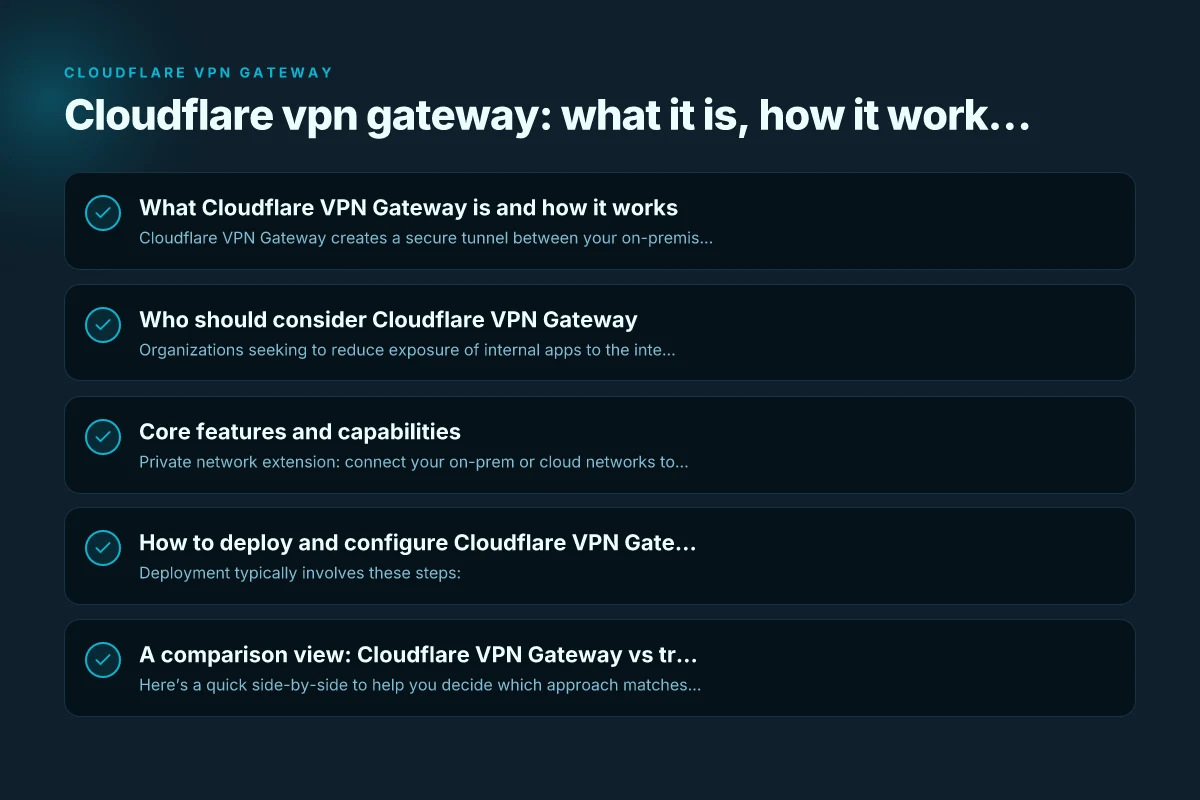
Who should consider Cloudflare VPN Gateway
- Organizations seeking to reduce exposure of internal apps to the internet
- Teams that use Cloudflare for DNS, firewall, and zero trust security and want an integrated private network layer
- Companies needing reliable, low-latency access to cloud resources and data centers from multiple sites or remote users
- Environments that require centralized monitoring, logging, and policy enforcement across a global network
Evaluating fit:
- If you already rely on Cloudflare Zero Trust and want to extend private access, VPN Gateway often fits naturally.
- If your workload requires deep, traditional VPN client connectivity for a large number of remote workers, you may consider whether VPN Gateway’s model aligns with your user experience.
- If you prioritize performance near Cloudflare’s edge and consistent security posture across regions, VPN Gateway provides a strong advantage.
Core features and capabilities
- Private network extension: connect your on-prem or cloud networks to Cloudflare’s edge, turning Cloudflare into a hub for private routing.
- Access control and identity integration: align access decisions with your identity provider and security policies.
- Traffic optimization: leverage Cloudflare’s network to minimize latency and optimize routing for systems behind the gateway.
- Observability: continuous visibility into who accesses what, with logs and telemetry to support security and compliance.
- Scalability: designed to support multiple sites and remote users without a complex mesh architecture.
How to deploy and configure Cloudflare VPN Gateway
Deployment typically involves these steps:
- Plan the network topology: identify sites, data centers, and remote users that will route through VPN Gateway.
- Create VPN Gateway resources in your Cloudflare account: configure tunnels, routing, and IP addresses.
- Establish tunnels from your sites: deploy compatible VPN devices or software on-premises or in the cloud to connect to Cloudflare.
- Define access policies: set who can reach which resources, applying zero-trust rules and least-privilege access.
- Test connectivity and failover: validate routes, measure latency, and ensure automatic failover if a tunnel drops.
- Monitor and adjust: leverage Cloudflare’s logs and dashboards to refine policies and performance.
Note: Exact steps can vary based on your environment (on-prem vs cloud, hardware vs software VPN endpoints) and the Cloudflare plan you’re using. Cloudflare’s documentation provides guided setup for common configurations. Hetzner VPN gateway: A practical guide to using Hetzner’s VPN gateway services
A comparison view: Cloudflare VPN Gateway vs traditional VPN approaches
Here’s a quick side-by-side to help you decide which approach matches your needs.
| Aspect | Cloudflare VPN Gateway | Traditional VPN |
|---|---|---|
| Access model | Private access to apps via Cloudflare edge; centralized policy | Client-to-site or site-to-site; full network tunnel |
| Exposure | Reduces public exposure by keeping services behind edge | Requires public exposure or NAT for access to services |
| Management | Centralized policy and telemetry through Cloudflare | Often segmented across devices, consoles, and vendors |
| Latency & routing | Global edge network with optimized paths | Dependency on routing between sites; may have higher variance |
| Identity integration | Strong integration with Cloudflare Zero Trust and identity providers | Varies; may require added components for identity and MFA |
| Scalability | Designed for multi-site, remote workers, and cloud-first setups | Can be scalable but often heavier to manage at scale |
| Complexity | Simplified operation within Cloudflare ecosystem | Complex with hardware, software, and licensing across sites |
Security considerations and best practices
- Principle of least privilege: grant access to only the resources users need.
- Strong identity verification: integrate with a robust IdP and enforce MFA for remote access.
- Regular policy reviews: continuously audit who can access what and adjust as roles change.
- Segmentation: avoid broad access. Segment resources so that a breach in one area does not compromise others.
- Monitoring and alerts: set up alerts for unusual patterns, failed authentications, and anomalous traffic.
- Redundancy and failover: ensure tunnels have automatic failover and diverse paths to Cloudflare’s edge.
Common use cases
- Remote workforce: give employees secure, policy-enforced access to internal apps without exposing them publicly.
- Multi-site connectivity: connect regional offices to a single private network through the Cloudflare edge.
- Cloud-centric deployments: link workloads in AWS, Azure, Google Cloud, or other clouds to internal resources via Cloudflare.
- Data center migration: gradually move from on-prem VPN to a Cloudflare-powered private access layer.
- Zero Trust deployments: pair VPN Gateway with Cloudflare Zero Trust for comprehensive security posture management.
Implementation considerations and tradeoffs
- Integration with existing tools: assess how VPN Gateway will work with your current firewall rules, SIEM, and monitoring stacks.
- Bandwidth and licensing: understand the throughput limits and licensing implications for large user bases.
- Endpoint readiness: verify that your chosen VPN endpoints (hardware or software) are compatible and supported.
- Compliance needs: ensure the configuration aligns with regulatory requirements for data in transit and access auditing.
- Cost model: weigh the total cost of ownership, including potential savings from reduced internet exposure and centralized management.
Final considerations and recommendations
If you’re already invested in Cloudflare’s ecosystem, DNS, WAF, Zero Trust, and their edge network, Cloudflare VPN Gateway is a natural extension for private access. It offers centralized policy management, reduced public exposure, and the potential for lower latency when accessing internal apps and resources through Cloudflare’s edge. For organizations prioritizing edge-native security, simplified management, and scalable private networking, VPN Gateway is a compelling option.
Recommendation:
- Start with a pilot: connect a small number of sites or a single remote workforce to validate performance and policy alignment.
- Map your access needs: clearly delineate which apps or data centers require private access and what identities will grant permission.
- Integrate with Zero Trust: pair VPN Gateway with Cloudflare Zero Trust for stronger identity-driven access and better visibility.
- Plan for scale: design tunnel topology and policies with future growth in mind, ensuring you can onboard more sites and users without complexity.
If you’re weighing Cloudflare VPN Gateway against traditional VPNs, consider your organization’s architecture, the value of edge-based security, and how much control you want over access policies. For many modern enterprises moving toward zero-trust and cloud-first networking, VPN Gateway provides a cohesive, scalable path that aligns with Cloudflare’s broader security and performance promises.
| VPN | Obfuscation | From / month | Plan | Free plan | Refund | Alipay | UnionPay | Crypto | Website opens in China | Trustpilot | |
|---|---|---|---|---|---|---|---|---|---|---|---|
 ZoogVPN | Turn on manually Shadow | $2.49/mo | 27 months: $59.99 | Yes | 7 days | ✓ | ✓ | ✓ | ✓ | Official site blocked; our special link opens (4.4 s) | 4.2/5 (195 reviews) |
 NordVPN | Turn on manually Obfuscated Servers / NordWhisper | $3.49/mo | 27 months: $94.23 | No | 30 days | ? | ✗ | ✓ | ✓ | ✗ Blocked | 4.2/5 (51,628 reviews) |
 ExpressVPN | ✓ On by default all servers | $3.00/mo | 28 months: $84 | No | 30 days | ✗ | ✗ | ✓ | ✗ | ✗ Blocked | 4.4/5 (29,706 reviews) |
 Surfshark | ✓ On by default Camouflage, with OpenVPN | See site | See site | No | 30 days | ✗ | ✗ | ✗ | ✓ | ✗ Blocked | 4.3/5 (31,823 reviews) |
 Proton VPN | Turn on manually Stealth, free plan too | $2.99/mo | 12 months: $35.88 | Yes | 30 days | ✗ | ✗ | ✗ | ✓ | ✗ Blocked | 2.1/5 (1,040 reviews) |
 Astrill VPN | Turn on manually StealthVPN / OpenWeb | $12.50/mo | 24 months: $300 | No | See site | ✗ | ✗ | ✗ | ✓ | ✗ Blocked | 1.3/5 (110 reviews) |
 Private Internet Access | Turn on manually Shadowsocks, OpenVPN only | $2.03/mo | 40 months: $81.2 | No | 30 days | ✗ | ✗ | ✗ | ✗ | ✗ Blocked | 4.2/5 (11,033 reviews) |
 CyberGhost | Turn on manually selected servers | $2.19/mo | 28 months: $61.32 | No | 45 days | ✗ | ✗ | ✗ | ✓ | ✗ Blocked | 4.0/5 (24,178 reviews) |
 PureVPN | Turn on manually switch to OpenVPN | $1.69/mo | 60 months: $101.55 | No | 31 days | ? | ? | ✗ | ✓ | ✗ Blocked | 4.4/5 (17,994 reviews) |
 AdGuard VPN | ✓ On by default TrustTunnel | $2.99/mo | 24 months: $71.76 | Yes | 30 days | ✓ | ✗ | ✓ | ✓ | Official site blocked; our special link opens (3.7 s) | 4.3/5 (290 reviews) |
 Mullvad | Turn on manually QUIC / Shadowsocks / LWO | $5.61/mo | €5/mo | No | 14 days | ✗ | ✗ | ✗ | ✓ | ✗ Blocked | 3.2/5 (192 reviews) |
 Windscribe | Turn on manually Stealth / WStunnel | $5.75/mo | 12 months: $69 | Yes | See site | ✗ | ✗ | ✗ | ✓ | ✗ Blocked | 4.7/5 (13,355 reviews) |
 StrongVPN | Turn on manually Scramble, OpenVPN TCP | See site | See site | No | 30 days | ✓ | ✗ | ✗ | ✗ | ✗ Blocked | 4.4/5 (2,695 reviews) |
 LightXtreme 闪连 | Not listed | $7.08/mo | 12 months: $84.99 | Yes | 30 days | ✓ | ✓ | ✓ | ✓ | ✓ Yes (3.5 s) | No page |
Prices checked 2026-11-10 on each vendor's pricing page (cheapest long plan, USD). Check the vendor's checkout for the final price.
Obfuscation checked 2026-11-14 on each vendor's site and help center: "on by default" = nothing to set; "turn on manually" = switch protocol or mode in settings; "not listed" = the vendor describes no obfuscation.
Payment methods checked 2026-11-10 on each vendor's payment pages: all 14 take cards and PayPal; ✗ = not listed, ? = the vendor's own pages disagree.
China access: whether the official website opens from mainland China networks (tests the website only, not the VPN connection). Last checked 2026-11-18 01:02 Beijing time.
Trustpilot score and review count checked 2026-11-10.