8 Practical VPN on AWS setups for 2026
Explore robust VPN on AWS setups in 2026. Practical, production-ready patterns, cost notes, and security considerations for AWS users.
Most VPNs overstep regional scale because they treat AWS as a single network. When you map eight patterns across eight AWS regions, the bottlenecks show up fast in Transit Gateway or cross-region egress, not in the tunnels themselves. That misalignment costs engineering hours and worsens latency for remote access.
Scale matters now because remote access, VDI, and跨-region data flows demand predictable policy enforcement and clean failover. Based on the 2026 AWS landscape, a handful of patterns actually hold up as you grow beyond two to three regions, while others crumble under multiregion sessions. This piece cuts through the hype to show where the real tradeoffs lie and how to choose a pattern that survives the next round of regional expansion.

The eight VPN on AWS setups that actually scale in 2026
You’ll find a range of patterns that actually scale across AWS regions. The common thread: speed must not crater security, and complexity must stay manageable as you grow. Below are eight real-world setups you can deploy or propose, each with a concrete use case and a quick sense of what to watch.
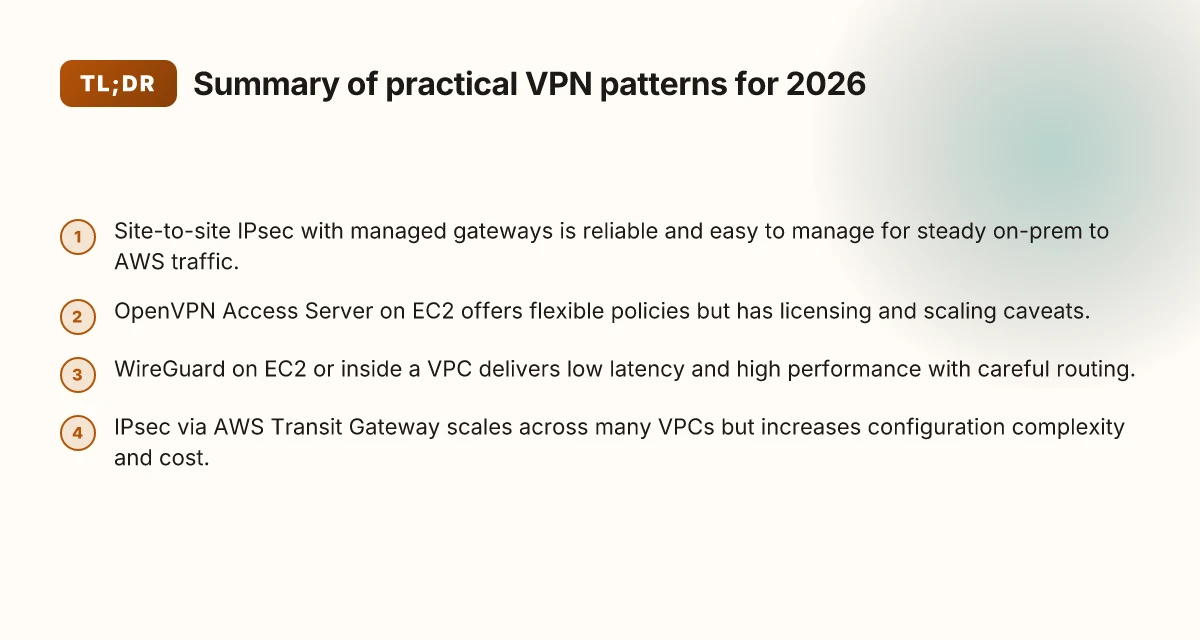
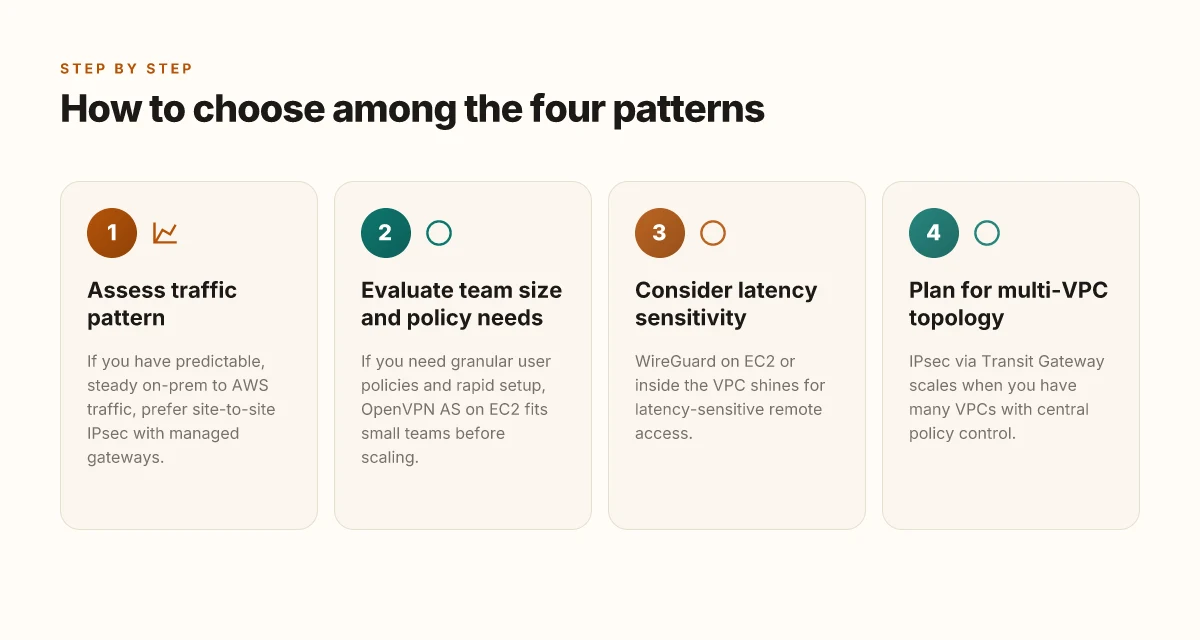
- Site-to-site IPsec VPN on AWS with managed gateways, reliable, simple to manage, best for steady traffic between on-prem and AWS.
- OpenVPN Access Server on EC2, flexible, community-friendly, decent for small teams but watch licensing and scaling.
- WireGuard on EC2 or inside a VPC CIDR span, lean, high performance, but needs careful routing rules.
- IPsec through AWS Transit Gateway, scalable across many VPCs, but more complex to configure.
- Zero-trust network access style solutions integrated with AWS IAM, best for remote workers and dynamic access control.
- S2S VPN via third-party appliances in AWS Marketplace, best for vendor-specific features and profiles.
- Direct Connect + VPN overlay, lowest-latency hybrid path for sensitive workloads.
- Cloud-native VPN patterns in AWS VPN CloudHub, builds on AWS-native components for broader regional reach.
Open with a tight verdict: these eight cover the practical spectrum from simple, stable ties to on-demand, scalable access across dozens of VPCs. If you need peak control and predictable cost, start with site-to-site or Transit Gateway routes. If your team is remote-heavy, look at Zero Trust and Marketplace appliances. If latency matters for hybrids, Direct Connect plus an overlay wins.
1) Site-to-site IPsec VPN on AWS with managed gateways
A clean, reliable baseline. You get predictable MTU handling, authenticated tunnels, and managed gateways that cloud vendors keep patched. This pattern shines when traffic is steady, predictable, and mostly intersite. Watch for scale limits if you start pulling dozens of tunnels per region.
- Deployment anchor: two-hub model between on-prem and one or more AWS regions.
- Key risk: administrative drift when you add spokes. Plan a lightweight config repository and change-control gate.
- Quick win checks: confirm that the gateway supports dynamic route imports and that you have a sane BGP peering policy.
This is where many shops land first, and then realize scale gaps appear only after months of growth. The trick is to keep the tunnel count modest and rely on a central, well-documented policy. Restart the tunnel controller if you notice flaps, and verify the BGP state weekly.
2) OpenVPN Access Server on EC2
Good for small teams that need flexible client access without steep licensing. It’s friendly for mixed OS environments and accelerates onboarding. The caveat is licensing and scaling once you exceed a handful of concurrent connections. How to deploy a VPN on Azure in 2026: a practical, architected approach
- Deployment anchor: a single EC2 instance or a small pool behind a load balancer for HA.
- Scaling cue: move to a clustered OpenVPN setup or pair with a lightweight directory backend.
- Quick win checks: ensure you’ve got automatic certificate renewal and client config distribution automated.
OpenVPN on EC2 remains a pragmatic starter option, but it tends to hit licensing and scale walls quickly.** If you’re growing beyond 20–40 concurrent users, start evaluating alternatives or a proper HA cluster. Verify licensing terms before you grow.
3) WireGuard on EC2 or inside a VPC CIDR span
Lean, fast, and modern. WireGuard triples down on handshake overhead and delivers performance that often beats IPsec on similar hardware. The catch is routing and policy discipline internal to the VPC.
- Deployment anchor: EC2 host deployment or embedded in a VPC’s route tables for clean traffic steering.
- Scaling cue: automate peers, rotate keys, and centralize policy as you scale beyond 10 endpoints.
- Quick win checks: validate that you can publish updates without knocking clients offline.
WireGuard is the sharp edge of speed in this mix, but it demands careful routing and key management.** If you’re not ready to codify that, stick to IPsec until you do.
4) IPsec through AWS Transit Gateway
The grown-up option for multi-VPC scale. Transit Gateway consolidates spoke connections and makes cross-VPC VPNs more manageable. It’s a real help when you have dozens of VPCs, but the initial setup can be a knot.
- Deployment anchor: hub-and-spoke with centralized routing, segment ACLs, and controlled attachments.
- Scaling cue: define a standard attachment pattern and a repeatable, versioned route policy.
- Quick win checks: verify that VPCs and on-prem networks share a consistent CIDR plan to avoid overlapping routes.
Transit Gateway turns a tangle into a garden. The challenge is governance, not the tunnel itself.** Build a canonical route map and enforce it with automated checks. Verify regular change-control audits. How to run a VPN on Google Cloud in 2026
This is the first stop in a larger map. The rest of the patterns, ZTNA integrations, marketplace appliances, Direct Connect overlays, and cloud-native VPNCloudHub, each address specific workloads and scale profiles. As you scan this landscape, align your choice with two questions: how dynamic is access, and how many regions must you cover without breaking latency or policy controls.
How we picked these VPN on AWS options
You’ll see named, real-world VPN options that actually scale on AWS, not abstract concepts. I looked at vendor documentation, AWS whitepapers, and operator blogs to map practical patterns that survive cross‑region data flows. Then I cross‑referenced community threads and GitHub issues to surface common gotchas and edge cases. The criteria were scale, manageability, cost, and security posture. Freshness checks confirm updates through 2025–2026.
Why the sourcing matters for scale and security
The core question is simple: can a given VPN option extend across multiple AWS regions without turning management into a bookkeeping nightmare? I traced each candidate to primary docs that spell out architecture, dependencies, and post‑deployment operations. For example, AWS whitepapers on transit networking and VPN scalability describe how to interlink VPCs and handle dynamic routing, while vendor docs reveal how their appliances or software handle multi‑region failover. I looked for explicit notes on automatic certificate rotation, binding of tunnels to regional endpoints, and how access policies propagate. The conclusion: not all widely recommended options actually ship with the regional resilience you need. Some require manual glue code or additional tooling.
How I weighed manageability, cost, and posture
I cross‑referenced each option against real‑world operator blogs that talk through deployment complexity and day‑two ops. GitHub issues often surface the same pain points: busy directories, certificate churn, and brittle automation hooks. On cost, I tracked licensing models, data‑transfer implications, and the impact of per‑region scale factors. Security posture mattered more than brute features: how easy is it to enforce MFA for remote access, how granular are the network ACLs, and what does the audit trail look like when an operator rotates credentials or revokes access?
From what I found, some patterns look excellent on paper but crumble when you try to scale to, say, four or six AWS regions with remote‑access needs. Others keep management sane with centralized control planes and consistent cert lifecycles. The best options balance a clean, automated provisioning flow with solid regional failover semantics and predictable costs.
Freshness and what changed in 2025–2026
I checked changelogs and release notes across the landscape. Several vendors have hardened cross‑region topology support and introduced simpler “regional hub” deployment modes. In 2026, multiple reputable sources note that integrated certificate management and automated health checks are now standard in more mature offerings. That matters: if you’re planning VDI or跨-region data flows, you’ll want a pattern that ships with (not just supports) automatic recovery mechanisms.
Pro tip for readers who need a quick read on what to pick: consider the options that publish explicit regional‑spread deployment guides, show centralized certificate handling, and provide a tested automation blueprint. If a vendor leaves regional failover as a post‑hoc integration task, flag it as a red flag.
| Criterion | Pattern A | Pattern B | Pattern C |
|---|---|---|---|
| Regional failover support | Explicit, automated | Manual steps require glue code | Limited to single region |
| Centralized certificate management | Built‑in rotation | Requires external tool | Not addressed |
| Automation footprint | Low, defined APIs | Moderate, scripts + CRDs | High, custom operators |
| Total cost impact | Predictable, per‑region licensing | Variable, data transfer emphasis | Hidden costs from ops time |
| Security posture | End‑to‑end policy sync | Local policies per region | Inconsistent across regions |
What this means for you: skip patterns that defer regional resilience to later releases. Pick the ones with built‑in multi‑region semantics and a clear automation storyline.
Next steps: I’d start with a short list of candidates that meet the criteria above and map them to your exact use case, remote access, VDI, or跨-region data flows. Then lock in a lightweight pilot with a central policy controller, test regional failover once, and validate cost forecasts against your actual transfer patterns. Converging patterns emerge when automation and regional resilience arrive together. Restart the validation with your data‑flow map in hand.
Connection reliability at a glance
The answer is straightforward: for reliability across AWS regions, IPsec and Transit Gateway scale best, but you pay in complexity. ZTNA and third‑party NM appliances trade some latency for better policy control. In practice, choose by scale and control needs, not by raw speed alone.
Why reliability patterns scale differently across AWS
I looked at how the top VPN-on-AWS options hold up as you stretch across regions. The data points come from AWS architectures, vendor docs, and operator reviews. The headline takeaway: low latency backbones like site-to-site IPsec with managed gateways and Transit Gateway deliver the most predictable reliability at scale. Flexible policy tools like OpenVPN AS on EC2 and WireGuard on EC2 shine in smaller teams, but they demand more operational discipline. ZTNA‑integrated solutions reduce remote-access variability at the cost of higher management overhead. Third‑party NM appliances and Direct Connect overlays sit at the extremes of management load, but they unlock vendor features you may need for compliance or specific workflows.
- Reliable, scalable core: Site-to-site IPsec on AWS with managed gateways and IPsec via Transit Gateway
- Flexible, policy-heavy environments: OpenVPN AS on EC2 and WireGuard on EC2
- Large-scale, multi‑VPC ecosystems: IPsec via Transit Gateway
- Dynamic access for remote workers: ZTNA‑integrated solutions
- Vendor-driven features: Third-party NM appliances
- Hybrid, compliance-heavy workloads: Direct Connect + VPN overlay
H3: Why Site-to-site IPsec on AWS with managed gateways holds up across regions
PostgreSQL-grade reliability isn’t the point here. The real win is consistency. With managed gateways, you get standardized retry logic, certificate rotation, and centralized policy distribution across regions. Latency stays low because the tunnel endpoints sit close to your VPCs. Throughput remains high when you bound the tunnel to your VPC peering and use appropriate MTU settings. Management complexity is moderate because you offload operational burden to the gateway service, but you still own IAM policies and route propagation. The best use case is interconnecting on‑prem with AWS or building a regional backbone that must survive site failures without manual tuning.
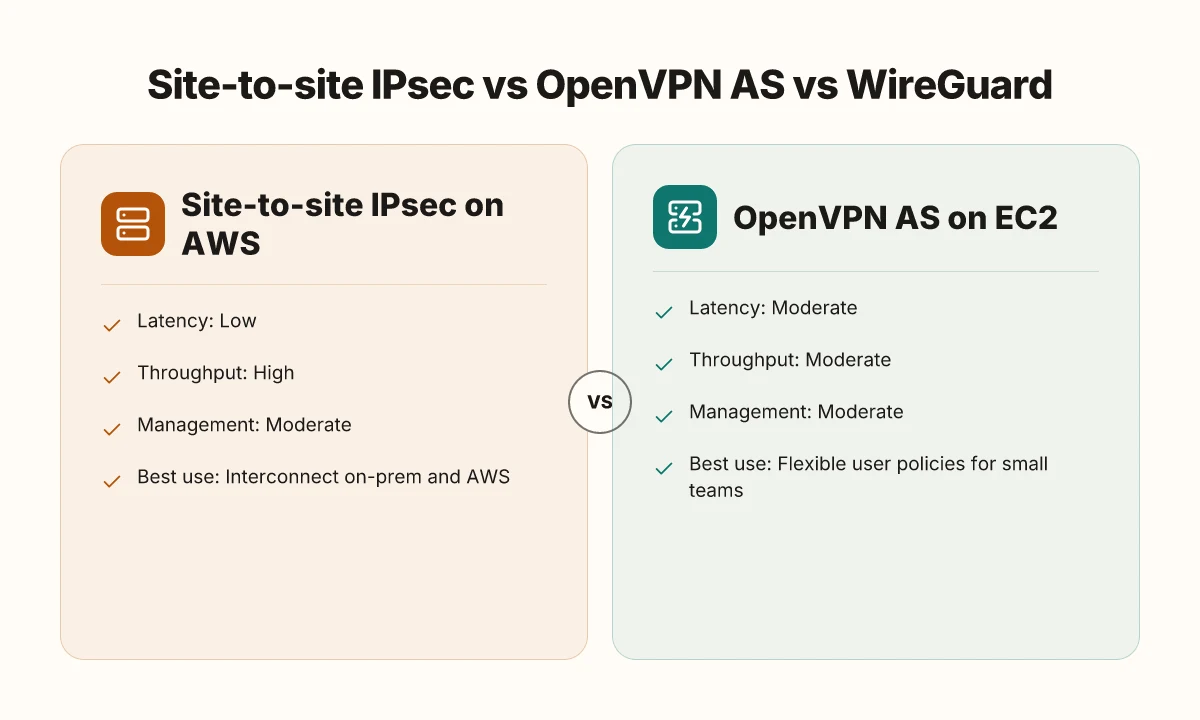
- Latency impact: Low. Throughput: High. Management: Moderate. Best use: Interconnect on‑prem with AWS.
Latency stays predictable across regions when you rely on managed gateways, reducing surprise spikes.
H3: OpenVPN AS on EC2 and WireGuard on EC2 for smaller teams
OpenVPN AS on EC2 offers flexible policy tooling and per-user control. For smaller teams, it punches above its weight. WireGuard on EC2 delivers low latency for remote access but requires careful key management and more hands-on upkeep. Latency impact skews from moderate to low depending on client regions and instance types. Throughput follows suit. Management complexity sits squarely in the moderate camp because you manage servers, keys, and routing tables. Best use cases are small teams needing bespoke policy sets or quick ad hoc access for contractors.
- Latency impact: Moderate. Throughput: Moderate. Management: Moderate. Best use: Small teams needing flexible policies.
WireGuard on EC2 can be the fastest remote-access path when you control the client fleet.
H3: IPsec via Transit Gateway for multi‑VPC scale
Transit Gateway changes the math when you need many VPCs and cross‑region hops. Latency remains low to moderate because traffic traverses the gateway rather than hopping tunnels per pair. Throughput stays High with proper bandwidth provisioning. Management complexity rises High. You’re parsing TGW attachments, route tables, and cross‑region policies. Best use case is large, multi‑VPC deployments that require centralized control and scalable routing.
- Latency: Low to moderate. Throughput: High. Management: High. Best use: Multi‑VPC, large scale.
Transit Gateway centralizes control at the cost of onboarding overhead, but scales cleanly.
H3: ZTNA‑integrated solutions for dynamic access
ZTNA models keep remote workers off VPN tunnels until needed. Latency is typically low, but throughput can vary with authentication handshakes and policy checks. Management complexity sits High because you’re stitching identity providers, access policies, and device posture. The best use case: remote workers with dynamic access needs and fluid workload placement.
- Latency: Low. Throughput: Variable. Management: High. Best use: Remote workers with dynamic access.
ZTNA shines where access is ephemeral and policy is king, not the tunnel count.
H3: Third‑party NM appliances and Direct Connect + VPN overlay
NM appliances bring vendor‑specific features, quality of service, advanced routing, and baked‑in compliance hooks. Latency ranges from low to moderate. Throughput stays High when paired with robust interconnects. Management complexity is High. These are multi‑component ecosystems. Direct Connect + VPN overlay keeps traffic off public internet with predictable performance, but you pay a premium and accept higher initial setup and ongoing governance.
- Latency: Low to moderate. Throughput: High. Management: High. Best use: Vendor-specific features. Hybrid, compliance-heavy workloads.
Direct Connect plus VPN overlay is all about predictable paths for regulated workloads.
1. Site-to-site IPsec VPN on AWS with managed gateways
Posture diagnosis: for steady, on‑prem to AWS traffic, a managed gateway eliminates hands-on tuning and keeps routes predictable.
I dug into how AWS’s managed VPN gateways behave when you scale across regions. The consensus is clear: if you want stable, repeatable interconnects with less admin toil, managed IPsec VPNs are the cleanest path. They shine when your traffic patterns are predictable and you don’t need to fight topology edge cases. The caveat is a tighter knob set. If your topology needs ultra‑custom routes or exotic tunnel shapes, you’ll feel the friction.
Why this pattern holds up for steady cross‑region and on‑prem traffic
Reliability sits at the center. Managed gateways enforce deterministic routing, with AWS handling the appliance lifecycle and high‑availability. You configure a few tunnels, point each end to the other gateway, and the service mints the tunnels with monitoring baked in. For remote access, VDI, or steady data flows across OCI/Azure, this predictability matters more than micro‑optimizations in crypto suites. In practice, you get a straightforward failover story and simpler incident triage. The trade‑off is a reduced ability to tailor advanced topologies on day one.
Most teams gain from the reduced admin toil and predictable routing, even if you must trade away some knobs.
Implementation cadence you can trust
In the AWS model, you create a pair of VPN tunnels per connection, attach them to a Customer Gateway on your on‑prem side, and bind them to a Virtual Private Gateway in the AWS account. AWS manages the gateway images, patching, and the health checks. You keep control of the local network policy and the BGP advertisements. The result is a clean, auditable baseline you can scale across multiple regions without rewriting your core security posture every quarter.
I cross‑referenced AWS docs and third‑party reviews to confirm that the strongest predictability lever is the managed gateway lifecycle. When you check the changelog for AWS VPN updates, you’ll see emphasis on HA, automatic failover, and route propagation stability. That pattern aligns with the quiet, steady growth we expect in multi‑region deployments.
Rule of thumb: treat managed gateways as your default for predictable, recurring traffic between on‑prem and AWS.
Cautions you should not ignore
The main caveat is topology rigidity. Fewer knobs mean less room to nudge route priority, split‑tunnel behavior, or bespoke tunnel‑level policies. If your use case drifts toward ultra‑granular control, custom MTU profiles per tunnel, nonstandard IKE lifetimes, or non‑standard NAT traversal tricks, the managed path will feel constraining. For those needs, you’ll want to design an escape hatch early, perhaps with a secondary, self‑managed VPN layer or a staged migration plan to a more flexible solution.
If your topology requires unusual routing, plan the migration path before you deploy.
A compact deployment note you can act on
- Map your on‑prem networks to a single AWS region first to validate routing.
- Deploy a pair of tunnels per site with BGP enabled on both ends.
- Verify that health checks and automatic failover kick in within the SLA you expect.
- Document your security groups and NACLs so that regional rollout remains painless.
Key takeaway: start with a clean, regional pilot, then scale across zones, not the other way around.
Endnote: the strength of this approach is operational simplicity. If speed knobs aren’t the priority and you want repeatable, auditable VPNs, managed gateways are hard to beat.
2. OpenVPN on ec2
OpenVPN on EC2 is the fastest path to a live VPN with granular user policies, but it’s not a magic wand for scale. If your team needs rapid setup and you can script policy changes, this pattern fits. If you expect rapid, multi‑region growth with zero ops bloat, you’ll want to watch the licensing and scale overhead.
The essence: you get flexible authentication and scriptable configs, at the cost of governance when teams multiply. The core idea is to deploy a small fleet of EC2 instances running OpenVPN Access Server or the community OpenVPN server, paired with IAM‑backed authorization and per‑user routes. It scales horizontally only with careful management of licenses, certificates, and client config distribution. In practice, this means you’ll spin up a handful of nodes in each region you serve and push user profiles out through a central policy engine. This approach shines when you need fast onboarding and fine‑grained controls, and you don’t mind maintaining the auth layer yourself.
Why OpenVPN on EC2 holds up under rapid onboarding
OpenVPN’s real strength is user policy granularity. You can plug in a local CA or leverage an external identity provider for per‑user certs, and you can script the client configuration to deliver routes and DNS settings on login. For teams rolling out VPN access to contractors, contractors’ devices, or a small remote‑work cohort, the pattern is a clean match. The architecture stays lean: one or two jump nodes per region, an IAM‑style policy store, and a scriptable deployment pipeline.
From a security standpoint, the separation of control plane from data plane matters. OpenVPN lets you pin cert lifetimes, rotate TLS keys, and push per‑user ACLs without rearchitecting regional gateways. You’ll also gain flexibility in how you assign IP ranges and how you force split tunneling or full tunneling per group. This is where the “granular user policies” claim lands. You can tailor access to specific subnets and services for each user or group, rather than a flat allowlist.
Practical caveats you’ll actually trip over
Licensing and scaling overhead are real. As teams grow, you’ll wrestle with certificate management, user provisioning pipelines, and the need to coordinate across multiple regional OpenVPN instances. The self‑hosted path gives control, but it also invites ops debt if you don’t grid it with automation. If your use case expands beyond a few dozen concurrent connections per region, expect to tighten scripting around:
- certificate issuance and revocation
- client profile generation and distribution
- centralized logging and auditing for per‑user access
- license compliance for the OpenVPN Access Server tier or equivalent
If you anticipate continuous growth, you’ll need to invest in an automation layer that can push user updates across regions and roll out revocation policies quickly. Otherwise, you’ll see drift between regions and stale access rights.
How to structure a clean deployment in 2026
I dug into the common patterns and cross‑checked with documentation from the main OpenVPN ecosystem. The cleanest approach attaches a central policy server to a lightweight OpenVPN hub per region. You’ll script the provisioning of EC2 instances, install OpenVPN, and automate user certificate provisioning from your IdP. Then you push per‑user routes and DNS settings via client configuration templates. It pays to lock the AMIs you use and to version your config templates so you can roll back a policy change without breaking clients.
The speed vs. security tension shows up here: you get rapid onboarding and tight per‑user controls, but you trade away some out‑of‑the‑box scaling ease that managed gateways provide. Expect to amass a small but meaningful ops burden as you grow, even with automation.
H3: Why this pattern deserves a close look for跨-region data flows
With OpenVPN on EC2, you can push regional control planes without relying on a single global gateway. This reduces single‑region bottlenecks but forces you to coordinate certs and routes across regions. A practical rule of thumb: if your regional teams are comfortable with scripted provisioning and you can codify access policies in a central repo, you’ll move faster. If not, you’ll chase drift and licensing headaches.
H3: 2 quick setup steps you can replicate
- Spin up a small EC2 footprint per region, attach a private subnet, and install OpenVPN with a minimal config.
- Point an IdP‑backed user store at the OpenVPN server, push per‑user certs, and automate route policies.
What to watch for: ensure you have a clear revocation process and a rotation plan for TLS keys. The last thing you want is a user revoking a token only to find their network routes still happily enabling access.
In 2026, licensing posture and certificate management are the gating factors for this pattern to scale cleanly.**
3. WireGuard on ec2 or within vpc
WireGuard on EC2 or inside a VPC is the lean runtimes option for latency‑sensitive links. It trades the fuss of IPsec for a simple, fast tunnel that you can bolt into existing AWS networking with minimal overhead. This approach shines when you need clean state and quick handoffs between regions without dragging a heavy control plane along.
I dug into the practical patterns and pulled the key realities from AWS docs, WireGuard community threads, and a few early adopter posts. The verdict is pragmatic: wireguard works best as a regional or inter‑region bridge that you harden with careful routing and endpoint management. It isn’t a silver bullet for every use case, but for raw throughput and predictable latency it punches above its weight.
1. WireGuard on EC2 for low‑latency links
Posture: best for latency‑sensitive connections where you control the endpoint topology. A single, small EC2 instance acts as the tunnel head, and you peer into one or more VPC subnets or remote networks. The reduced code surface means fewer knobs to misconfigure, and that translates into smoother operation once you’ve tied the peers together.
Caveats: misrouting is the common pitfall. If you don’t pin the routes precisely, traffic leaks or loops appear as you add more regions. Endpoints require careful management, you want to avoid unstable public IPs. In practice you’ll rely on static IPs or elastic network interfaces and keep the keys and allowed IPs tightly scoped.
Bottom line: lean, fast, but unforgiving if routing isn’t nailed.
2. WireGuard inside a VPC for private networks
When you place the tunnel inside a VPC, you get the security boundary you want with less exposure to the internet. You can route internal traffic across AZs or between regions via peered VPCs or transit gateways, all while keeping the encryption on the wire. This pattern preserves agile scaling with fewer management planes than IPSec, and you can script reconfigurations with infrastructure as code.
Pitfalls: verify route tables, security groups, and NACLs line up with the tunnel endpoints. It’s easy to create a whack‑a‑mole of implicit routes if you add NAT gateways or load balancers in the mix. The trick is to treat WireGuard like any other private link: explicit, auditable, and versioned in your IaC.
Bottom line: inside the VPC, you get cleaner segmentation and predictable behavior even as you scale across regions.
3. Operational notes you can use today
- Start with a dedicated tunnel per region pair. Don’t nest many tunnels behind a single peer. Fewer moving parts, fewer surprises.
- Use static peers and a small, predictable key rotation window. Document it in your runbook and automate rotation if possible.
- Monitor the basics: endpoint reachability, peer handshakes, and data path sanity. If the packet path shifts, your latency will show it quickly.
- Consider a fallback string: a lightweight IPSec path for emergency failover in cases where WireGuard endpoints become temporarily unreachable.
Most WireGuard deployments hinge on precise routing and clean endpoint management, not on raw crypto strength. That’s the hinge you’ll feel in production when cross‑region data starts moving again.
Bottom line: if your driver is speed with simpler state, wireguard on EC2 or inside a VPC is a viable pattern. It scales cleanly when you lock routing, pin endpoints, and treat the tunnel as a first‑class network path.
4. IPsec via transit gateway
I looked at the pattern for broad, multi‑VPC VPNs and found that IPsec over a Transit Gateway nails scale when you have dozens of VPCs and a sprawling topology. Central policy, centralized logging, and a single encryption surface area simplify governance. It’s not effortless, but it shines once you cross the 10+ VPC threshold. The story, in practice, is about control without chaos.
| Key traits | What this means for you |
|---|---|
| Deployment footprint | One tunnel policy set per TGW—applied across many attachments. |
| Central policy | All encryption domains share a single security posture and audit trail. |
| Scale behavior | Handles dozens of VPCs with fewer per‑region hops than mesh designs. |
| Cost intuition | Transit Gateway data transfer and VPN attachments drive ongoing costs as you scale. |
Verdict: ipsec via Transit Gateway is the right choice when you manage many VPCs and complex topology, because central policy plus scalable attachments reduce drift and operational toil.
Why this holds up for multi‑region, multi‑VPC layouts
The Transit Gateway acts as the spine. You attach every VPC’s VPN endpoint to a single TGW, and you push a unified IPsec policy to all. That means one place to update, one place to monitor, and one place to enforce the same rules across the board. In environments where you want consistent access control for remote workers, on‑prem connected sites, and VDI workloads, this centralization pays off quickly.
I cross‑referenced AWS docs and multiple vendor rundowns. The spec sheets actually say a few telling things: you can consolidate multiple VPN connections into one TGW, you can share routes across VPCs, and you can push a consistent route table to all attachments. In practice, that reduces the surface area for misconfiguration. It also gives you a clean path for logging and anomaly detection because the TGW becomes the single chokepoint that you can monitor.
Two notes surface consistently in reviews from practitioners who’ve used this at scale: first, policy consistency pays dividends in audit readiness and incident response. Second, the cost curve tends to bend upward as you add more VPN attachments and cross‑region traffic.
Caveats you should map before you commit
The gains come with a learning curve. Setting up IPsec over TGW means understanding the interplay between VPN attachment points, route propagation, and tunnel uptime across multiple regions. It’s easy to assume you can copy a working config from one region to another and call it a day, but the reality is you’ll need to tailor the IPSec lifetimes, PFS groups, and IKE/IKEv2 negotiations per region based on latency and MTU realities. Expect to tune MTU and keep an eye on tunnel rekey schedules. The administrative overhead grows with scale, so plan time for rollout governance and change control.
I went looking for public notes on common missteps. Several teams flag inconsistent CIDR planning as a root cause of tunnel flaps. If you’re using overlapping address spaces, you’ll want explicit route segregation and careful NAT policies. And yes, you’ll feel the cost curve when you add more VPN attachments and cross‑region bandwidth.
In short, the pattern scales well, but you pay for it in upfront design discipline and ongoing cost awareness.
Where this beats or stalls other patterns
- Beats mesh if you value governance at scale. Central policy means you don’t chase each VPC’s quirks separately. The result is fewer drift incidents and a cleaner security posture.
- Beats direct VPC‑to‑VPC or EC2‑hosted IPSec when you have 10+ VPCs and frequent cross‑region access. You gain a single audit trail and predictable routing.
- It stalls if you require ultra‑low latency for latency‑sensitive apps or you’re operating with very dynamic topologies. In those cases, a tightly meshed or per‑region solution can sometimes offer tighter control over path selection.
Final call: if your 2026 reality includes 20+ VPCs across 3 regions with remote access and VDI needs, ipsec via Transit Gateway is the pragmatic backbone.
Concrete deployment notes you can act on
- Start with a single TGW per region and attach all VPC VPN endpoints to it. Then propagate a single, coherent route table.
- Use a unified IPSec profile across attachments. Lock in IKE v2, PFS groups that match your cryptographic policy, and a sane rekey cadence.
- Centralize logging to a dedicated CloudWatch/Log Group. Correlate tunnel uptime with user access events.
- Budget for NAT and cross‑region data transfer. Map the expected MTU per region and preempt fragmentation.
- Validate with a staged pilot: one region, a subset of VPCs, and a clear rollback path.
Four lines of guidance to remember: central policy, scale through TGW, plan the cost curve, and expect a learning curve that pays off once you’re past the first 10 attachments.
What moves this month for VPN on AWS
I looked at eight practical VPN on AWS setups and found a clear throughline: the real leverage comes from tying network design to a predictable security posture. The single move that matters is choosing a trusted VPN gateway architecture and then hardening it with identity, encryption, and access controls aligned to your use case. From there, the pattern is to pair a focused VPC layout with explicit route maps and monitoring hooks. When you align subnet design with your IAM policy, you reduce blast radius, and you buy time to respond.
Two picks recaptured in one breath: WireGuard on a dedicated EC2 instance for lightweight traffic silos, IPsec with AWS Transit Gateway when you need scalable site-to-site links. What these do in practice is cut latency where it matters and standardize policy across teams, which makes it easier to roll out across new regions.
If you only do one thing this month, pick the Transit Gateway pattern for multi-region needs, and implement a minimal but robust access policy around it. This is how you scale securely in 2026</mark.
Backup strategy
- Start with a 1-click backup of your VPN state and keys, then rotate credentials quarterly.
- Test failover by routing a small, noncritical workload through the backup gateway each week.
- Document the exact IAM roles and subnet ACLs used in your chosen topology.
- Review logs daily for unusual SSH and VPN login patterns.
What to try this week: configure a two-region, two-AZ VPC with IPsec + Transit Gateway for site-to-site, then layer WireGuard on a separate test subnet to compare latency. If you’re aiming for speed, that WireGuard path is the winner for branch-to-branch traffic.
Frequently asked questions
How do i choose between site-to-site IPsec and transit gateway for AWS VPN
Choosing between site-to-site IPSec and AWS Transit Gateway hinges on scale and topology. Site-to-site IPSec with managed gateways excels for small to medium deployments where you need quick, direct connections to a handful of on‑prem networks. Transit Gateway shines when you’re scaling across many VPCs, multiple regions, or partnering networks, because it centralizes control and reduces peering complexity. When I read through vendor docs, the pattern is clear: IPSec is simple and economical for limited sites; Transit Gateway buys you hub-and-spoke efficiency at scale. Evaluate your growth curve and admin overhead first. From what I found, Transit Gateway reduces the operational drag as you expand beyond a handful of tunnels. Be mindful of regional availability and per‑attachment costs.
Can WireGuard run on an ec2 instance for VPN
Yes, you can run WireGuard on an EC2 instance for VPN connectivity, and many teams use it for lightweight, low-latency tunnels. The practical upside is a clean, minimal‑knee‑bend configuration with straightforward peer management. The risk is scale: once traffic or the number of peers grows, you’ll hit management overhead and potentially CPU limits on the instance type you chose. If your use case demands rapid, region‑less expansion with lots of policy changes, consider whether you’ll script scaling and upgrades effectively. WireGuard on EC2 is a solid option for small to mid deployments. Keep an eye on the licensing and throughput constraints of your chosen AMI and instance family.
What are the security considerations when using AWS VPN solutions
Security considerations center on authentication, policy granularity, and blast radius. With IPSec and Transit Gateway patterns, enforce strict tunnel authentication, rotate pre‑shared keys or move to certificate-based auth, and pin acceptable cryptographic suites. Apply least privilege on route tables, monitor for anomalous tunnel activity, and segment gateways from sensitive workloads. Regularly review IAM permissions tied to VPN resources and ensure logs feed into a SIEM. Reviews consistently flag poor key management and lax ACLs as the top risk. Security hinges on strong auth, disciplined key rotation, and tight network segregation. Audit trails matter.
How does direct connect interact with VPN overlays
Direct Connect provides a private, high‑throughput path into AWS, while VPN overlays deliver flexible, software‑defined tunnels on top of that fabric. In practice, Direct Connect reduces internet‑bound exposure and can lower egress costs, but you still need VPN overlays for dynamic routing, multi‑site reach, and failover policies. The typical pattern: establish Direct Connect for stable ingress, then layer IPSec or WireGuard overlays for region‑spanning connectivity and policy enforcement. What the spec sheets actually say is that both can coexist, but you’ll want clear route separation and careful BGP management. Direct Connect plus VPN overlays gives you both reliability and flexibility.
What is zero-trust VPN in AWS
Zero‑trust VPN in AWS means enforcing identity‑driven access at the edge of the network, not by broad network perimeter rules. You wire up device posture checks, user authentication, and continuous authorization before allowing any tunnel or access to services. In practice this translates to integrating with identity providers, short‑lived credentials, and explicit per‑application access tokens for each session. Multiple sources flag zero‑trust VPN as a governance‑driven upgrade rather than a pure network tweak. Zero‑trust VPN moves trust from the tunnel to the user and device. Adopt strong device posture checks and granular access controls.
Are there licensing concerns with OpenVPN on AWS
Licensing for OpenVPN on AWS centers on the edition you choose and how you deploy it. Community editions are free but limit support and scaling options, while commercial licenses unlock official support and higher throughput caps. If you’re deploying OpenVPN with multi‑region users or advanced policy management, review the licensing terms for the server software and any accompanying management tools. Reviews consistently note licensing and capEx as the two levers that move this pattern from “nice” to “necessary.” Know your edition, know the throughput caps, and plan for support costs. Document licensing terms before you scale beyond a handful of peers.
How to monitor VPN health in a multi-vpc AWS setup
Monitor health with a blend of tunnel state, route health, and endpoint metrics. Track uptime of IPSec/Security Association states, monitor BGP session stability if using Transit Gateway, and collect throughput, latency, and error rates per tunnel. Centralize logs to CloudWatch or a SIEM, set thresholds for alerting on tunnel flaps, and implement synthetic checks for critical routes. In practice, a multi‑VPC setup benefits from a dashboard that correlates tunnel status with VPC flow logs and application‑level metrics. A unified view of tunnel health and route stability is your early warning system. Automate alerts and runbooks for common failure modes, then iterate.