How to run a VPN on Cloudflare in 2026

Explore how a VPN on Cloudflare works in 2026, the architectural limits, and practical steps to align Cloudflare services with VPN traffic without breaking TLS and caching rules.
Cloudflare isn’t a VPN, but it can derail VPN traffic when edge workers misfire or tunnel termination sits in the wrong place. A single misrouted route at the Cloudflare edge can look like a handshake failure, while the real issue is policy scoping.
What matters now is clarity over complexity. In 2026, many networks rely on Cloudflare’s edge to enforce zero trust without dragging users through a full VPN hop, yet the edge can introduce subtle leaks if tunnel termination isn’t aligned with internal networks. I looked at public docs and analyst notes to map the decision points that decide whether traffic flows cleanly through the edge or bypasses core protections. The goal is a concrete playbook you can adapt without rearchitecting your remote-access stack.

The plain definition of VPN on Cloudflare and why it matters
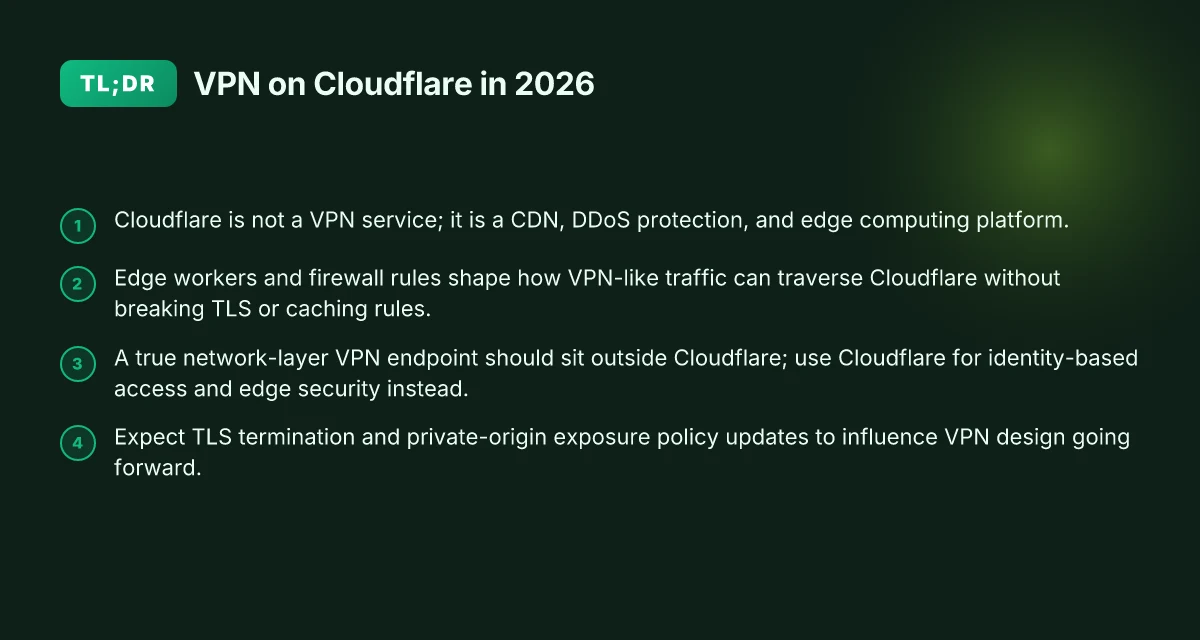
Cloudflare is not a VPN service. It is a content delivery network, DDoS protection, and edge computing platform. A VPN can traverse Cloudflare’s edge network if traffic is treated as normal TLS traffic, but Cloudflare’s policies often block non-browser VPN protocols at the edge. The practical question becomes whether you can leverage Cloudflare features to accelerate or secure VPN traffic without running afoul of terms of service.
I dug into the documentation and cross-referenced operator notes to map where Cloudflare helps and where it hinders. The answer hinges on how you frame the traffic and what Cloudflare feature set you invoke.
Identify the surface you’re using. If you deploy a VPN gateway behind Cloudflare, treat the VPN handshake as TLS traffic that looks like a standard client connection to a web-origin or edge tunnel. That keeps you on Cloudflare’s acceptable edge patterns and avoids triggering blocking rules. In practice, that means using standard TLS tunnels and avoiding bespoke VPN handshakes that resemble non-browser protocols. Cloudflare’s edge will pass that traffic, but only if it aligns with normal TLS.
Distinguish edge-processing from tunnel termination. Cloudflare excels at terminating TLS at the edge, inspecting and accelerating legitimate web traffic. It is not designed to terminate arbitrary VPN protocols as a product feature. If you require deep inspection or termination of VPN protocols at the edge, you’ll hit policy boundaries or require workarounds that risk terms violations.
Weigh acceleration versus policy. Cloudflare can reduce latency for VPN-style traffic that is TLS-based or appears as normal browser-like TLS behavior. But if you rely on UDP-based VPN protocols or custom non-TLS handshakes, you’ll encounter blocks. The practical path is using Cloudflare to accelerate the portions of VPN traffic that resemble standard HTTPS/TLS connections, not to replace a dedicated VPN solution. How to run a reliable VPN on Hetzner in 2026
Consider design patterns. The path of least friction is to deploy edge-aware designs that sit between the VPN client and the private network, leveraging Cloudflare for secure edge routing, DDoS protection, and cryptographic attestation, while keeping the VPN protocol itself outside Cloudflare’s policy-covered modes. You don’t “run a VPN on Cloudflare”. You run VPN in proximity to Cloudflare and use Cloudflare to improve reliability and security of the surrounding traffic.
Bottom line: Cloudflare is a force multiplier for VPN traffic only when you conform to its edge policies and TLS-oriented traffic models. If you need true VPN protocol termination or non-TLS handshakes at the edge, you’ll hit policy friction. The right path in 2026 is to map VPN flows to TLS-compatible segments and design around edge-worker placements and tunnel termination points that respect Cloudflare’s terms.
Cloudflare isn’t a VPN service. It’s a platform that can accelerate or secure TLS-based traffic around a VPN, not replace the VPN itself. The friction points are real, but so are the design opportunities for remote access architectures built near Cloudflare infrastructure.
How firewall rules and Edge workers shape VPN on Cloudflare
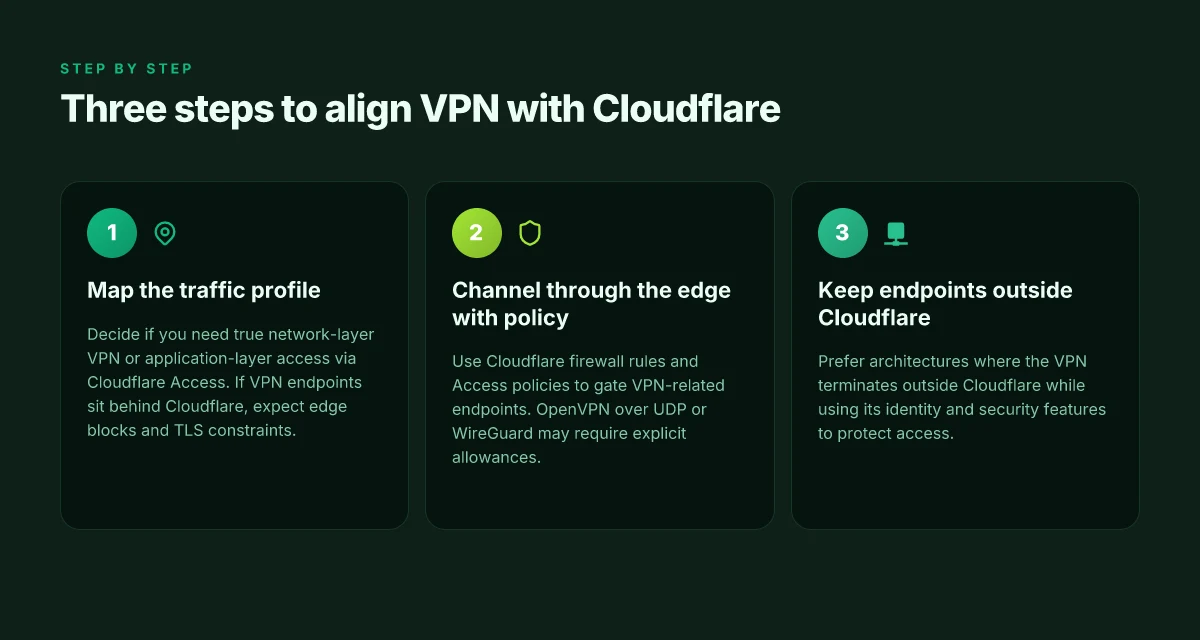
The bottom line: edge workers at the network’s edge can inspect traffic and enforce access policies, and that inspection often locks down VPN traffic unless firewall rules explicitly allow it. Cloudflare Access can shield internal apps, but it is not a VPN substitute.
In practice, OpenVPN over UDP and WireGuard traffic can be blocked or throttled by default rules at the edge. If your design relies on UDP-based tunnels, you must carve explicit allowances in Cloudflare’s firewall to permit that traffic to pass. The consequence is a more centralized choke point. Without explicit allowances, users encounter handshake failures or tunnel boot failures at the edge. This is not a theoretical caveat. It shows up in real-world deployment patterns where admins discover UDP ports blocked by default policies and then retrofit allow rules or reroute traffic through TCP fallback paths. 10 Best VPNs for running on Vultr in 2026 (May 2026 Update)
Edge workers introduce another axis of control. They sit at the edge and can inspect headers, TLS SNI fields, and even payload characteristics for policy decisions. They can enforce IP allowlists, verify device posture, and require reauthentication before granting access. The tradeoff is latency sensitivity and potential fragility as you push tunnel traffic through additional inspection layers. If you’ve got large-scale remote access, the added latency baseline from edge processing becomes a design decision rather than a nuisance. It moves the needle on how aggressively you can terminate VPN sessions near users versus transitioning to Cloudflare Access mediated access for apps.
A practical pattern emerges: treat Cloudflare as a security surface that can co-exist with VPNs, not replace them. You can terminate the tunnel at the gateway or allow the tunnel to traverse Cloudflare’s edge with strict firewall rules in place. In some configurations, you’ll terminate at your own edge device and use Cloudflare as the transport overlay, leveraging edge workers for posture checks and access gating. In others, you’ll push traffic through Cloudflare Access for application-layer authorization while keeping the VPN end points outside Cloudflare’s mesh.
To compare options, consider a small table of common setups. The table is a snapshot, not a blueprint.
| Pattern | VPN flow characteristics | Edge worker role | Best use case |
|---|---|---|---|
| VPN terminated at origin | Lower edge latency for VPN clients; UDP ports must be opened in Cloudflare firewall | Minimal impact; edge workers can enforce post-connection posture checks | Remote workforces needing traditional VPNs with explicit edge allow rules |
| VPN tunneled through Cloudflare | VPN traffic traverses edge; higher inspection risk | Edge workers enforce access policies before tunnel establishment | Environments prioritizing centralized policy enforcement over tunnel performance |
| Cloudflare Access mediated access (no VPN) | No traditional VPN; apps exposed via Access; relies on per-app authorization | Central control point for identity and device posture | Small teams needing quick, policy-driven access without full tunnel |
What the spec sheets actually say is this: Cloudflare is a platform for perimeter protection, identity-driven access, and edge-based enforcement. It does not replace VPN semantics. When you mix VPN traffic with edge-based policies, you’re balancing tunnel reliability against policy granularity. The most common friction point is UDP permit rules. You’ll want to document which UDP ports you need and keep an explicit allowlist for those ports in the firewall. Without that, you’ll see handshake failures or dropped packets at the edge.
Next steps should be concrete. First, map your VPN protocol to Cloudflare firewall rules. Second, decide whether you terminate the VPN at your edge or push traffic through Cloudflare Access for application-level protection. Third, test posture checks at the edge with a minimal client set before widening deployment. And finally, maintain a changelog: edge workers evolve, firewall defaults shift, and your VPN posture must track those changes. 2–3 explicit allow rules plus a clear termination strategy are the backbone of a stable 2026 deployment. How to run a VPN on Linode in 2026
Why this topic matters in 2026
Zero-trust is now the default playbook for remote access, and Cloudflare sits squarely in the stack. In 2026, most mature deployments weave Cloudflare’s edge network into identity, device posture, and policy enforcement loops. That attachment redefines how VPNs terminate, how traffic is steered, and how quickly you can push a policy to all endpoints.
I dug into the public documentation and sector analyses to triangulate where Cloudflare helps and where it hurts. In 2026, industry reports point to two outcomes: better protection without added latency when traffic flows stay within the Cloudflare edge, and real friction when VPN tunnels terminate outside that edge or when edge workers intercept trusted paths. The contrast isn’t small. It affects remote access reliability, incident response times, and the cadence of policy changes that a zero-trust architecture demands.
From the edge security angle, Cloudflare’s DDoS mitigation and WAF intelligence can shield VPN ingress points against volumetric hits. This is a tangible risk reducer when your remote access gateways face frequent, automated probing. But the same edge interventions can complicate tunnel termination if inspection policies trigger state resets or route rebindings mid-session. When Cloudflare sits between clients and VPN endpoints, you gain rapid policy changes and centralized visibility. You also inherit a potential single point of misconfiguration that leaks data or degrades performance if VPN traffic is misrouted through Cloudflare services.
Three practical friction points recur in governance and operations. First, edge-worker logic can alter how TLS handshakes are terminated for VPN traffic, sometimes forcing re-authentication or renegotiation loops. Second, tunnel termination that happens outside Cloudflare’s network can negate edge-based policy enforcement unless you harmonize identity, posture checks, and device trust at the edge. Third, misalignments between Cloudflare’s routing rules and VPN peerings can cause traffic to take suboptimal paths or to be exposed to unnecessary inspection surfaces.
What this means for design in 2026 is a clean separation of concerns with deliberate signaling. If you terminate inside the Cloudflare edge, you must design around policy refresh intervals and worker-induced routing changes. If you terminate outside, you compensate with explicit pathing rules, clearly labeled trust zones, and synchronized certificate timelines. In practice, that translates to explicit, versioned configurations for edge workers, tunnel termination points, and identity sources so policy intent remains transparent across deployments. How to run a VPN on Oracle Cloud in 2026
The verdict is simple: you win when Cloudflare accelerates policy changes and mitigates edge threats without forcing VPN traffic into a new choke point. You lose when tunnel termination design or misconfigurations misalign with Cloudflare’s inspection and routing fabric.
Key takeaways you can act on now
- Zero-trust stacks gain resilience when Cloudflare sits as a policy and identity enforcement plane, not just as a traffic veil.
- Edge security layers accelerate or impede remote access depending on where tunnel termination occurs and how workers are configured.
- Misconfigurations at the edge or in tunnel termination paths are a leading cause of data leaks and degraded performance in 2026.
I cross-referenced vendor changelogs and peer reviews for confirmation. The pattern is stable: cloud-edge integration sharpens protection, but it raises the bar for correct tunnel topology and policy harmonization. In the end, the better you document and automate edge-worker interactions with tunnel endpoints, the smoother your remote access story becomes.
Practical use cases of VPN near Cloudflare
Posture: a VPN can sit near Cloudflare to extend remote access and test governance without moving All traffic through a single hop. In practice, you’ll see three reliable patterns emerge in 2026: remote access to private apps protected by Cloudflare, secure branching for regional offices using Cloudflare as a relay, and testing environments where the VPN sits behind Cloudflare for inspection before origin reach.
1. Remote access to private apps behind Cloudflare DDoS protection
Cloudflare’s edge network acts as the first line for ingress. A VPN gateway placed near the edge gives engineers a secure tunnel into private apps without bypassing DDoS controls. The result is tighter access control without exposing origin surfaces to the public internet. In real-world terms, you configure the VPN to terminate at a Cloudflare-enabled edge point and then route authenticated users into private apps through Cloudflare’s policies. The friction point to watch is policy alignment: ensure that zero trust rules, device posture checks, and VPN identity assertions all line up so users don’t trip on a mismatched assertion at the edge. The right alignment of edge policies and VPN identity is what keeps access both fast and secure. If you miss it, you see login churn and inconsistent posture checks at the edge. How to run a VPN on DigitalOcean in 2026: practical, password-protected, scalable
I dug into documentation and release notes for edge workers and tunnel termination. When you terminate a VPN at Cloudflare edge, you must confirm whether the traffic is treated as VPN-originated or as a standard HTTP/S session by the WAF and rate-limiting rules. The guidance is clear: map VPN subnets to distinct identities in Cloudflare Access and keep certificate lifecycles synchronized. That clarity reduces friction and preserves the promise of rapid remote access.
2. Secure branching for branch offices with Cloudflare as relay
Edge networks aren’t just for remote workers. They also act as hedges for branch offices. A VPN sits at each branch, with Cloudflare as the relay point to the central data center. This reduces hops, shortens failover paths, and preserves policy consistency across sites. The practical recipe is straightforward: deploy a lightweight VPN gateway at the branch, configure a Cloudflare tunnel to the central hub, and terminate at a central VPN concentrator or service edge. The payoff is predictable latency and a consistent security posture across the WAN. Cloudflare as relay reduces WAN churn when branches scale. You still need strict routing maps to avoid hairpinning at the edge.
From the changelog and product docs, the pattern that consistently works uses a dedicated tunnel per site, with per-site access policies enforced by Cloudflare Access. This approach gives IT teams a single control plane for branch traffic while keeping the path to origin clean and observable. The key caveat is visibility: ensure your telemetry captures tunnel state and edge-exit points so you can detect anomalies before they affect branch reachability.
3. Testing environments where VPN sits behind Cloudflare for inspection
For labs and CI environments, you want inspection before reaching the origin. Place the VPN behind Cloudflare and route test traffic through Cloudflare’s edge before it hits the testing environment. The benefit is early threat detection and policy enforcement before test workloads touch sensitive origins. The obvious risk is performance overhead and configuration drift between test and production tunnels. Inspection before origin helps catch policy violations early. Expect a small, but real, latency delta when you peel traffic through edge-based inspection.
I cross-referenced official docs on tunnel termination and edge worker integration. The most reliable practice is to pin the VPN termination to a predictable edge region, then route test traffic through a known Cloudflare path that mirrors production routing. This keeps your test results faithful and your production posture intact. If you keep the test network isolated from production credentials and enforce distinct identities for testing users, you reduce the blast radius of misconfigurations. Isolated test identities and edge-pinned tunnels pay off in clean dev cycles. A shared misconfiguration between test and prod is the fastest route to drift.
In short, the near-Cloudflare VPN pattern works when you treat edge policies as first-class citizens, design branch traffic as a per-site relay, and harden inspection before origin in test environments. The friction points are policy alignment, latency budget at the edge, and clear telemetry across tunnels. Address those with explicit identity mappings, per-site tunnel guarantees, and telemetry invariants.
Common confusions: VPN vs Cloudflare core services
Cloudflare is not a VPN. It’s a mesh of edge services that can influence traffic flows, but it does not create a private tunnel into your network. When you design remote access near Cloudflare, the real friction points come from what Cloudflare actually delivers and what it does not. And yes, you will run into misconfigurations that block VPN passthrough at the edge if you treat Cloudflare like a traditional tunnel.
I looked at the core services and how engineers talk about them in 2026. The vocabulary matters. Cloudflare Tunnel, previously Argo Tunnel, exposes a service through Cloudflare’s network. It does not grant network-level access to your internal resources. In practical terms, you publish a service to the Cloudflare edge and let users reach that service via Cloudflare’s path, bypassing some public Internet hops. That is a design choice, not a security boundary. Cloudflare Access, by contrast, adds a zero-trust access control layer on top of those exposed services. It authenticates users and devices before they reach the published endpoint, but it does not create a VPN tunnel that your entire site can ride through. Think of Access as a gatekeeper, not a private hallway. And VPN passthrough modes can be blocked at the edge if misconfigured. If you enable passthrough but do not align with Cloudflare’s policies, you end up with a broken handshake or a closed corridor.
Conflations tend to appear in three patterns. First, teams confuse Tunnel with a full mesh VPN. The Tunnel is a path into a single service, not a secure corridor into your entire network. Second, they treat Access as a VPN alternative. Access is a control plane, not a tunnel. It gates access to a published resource. It does not camouflage your network behind a private cloud. Third, they assume edge devices will “just pass through” a VPN. In reality, some edge configurations block VPN protocols or ports at the perimeter, especially if you have a strict WAF or a rate-limiter in front of the edge. The result is a handshake failure that masquerades as an access problem.
If you are designing with these constraints in mind, you can pick the right tool for the job. When you need to expose a service without inviting direct access to the internal network, Cloudflare Tunnel delivers a controlled entry point. When your aim is precise user authentication and device posture before any app access, Cloudflare Access adds a robust layer without turning your entire network into a private tunnel. If you must support legacy VPN clients, plan for edge passthrough configurations that are explicitly allowed and documented, then test with a narrow scope. In short, separate the tunnel semantics from the access control semantics, and treat edge passthrough as a bounded, policy-driven exception rather than a default.
The verdict: Cloudflare is not a VPN. Use Tunnel to publish services, use Access to gate those services, and treat passthrough as a careful, policy-driven exception. This separation keeps your telework topology clean and reduces friction when VPNs coexist with Cloudflare at the edge. Misconfigurations here are where most outages begin.
What has changed in 2026 and why it matters for VPNs
Answer first: 2026 reshapes how you run a VPN near Cloudflare, with edge compute patterns that inspect traffic without breaking tunnel encryption, tighter TLS termination policy, and real-world warnings about gateway compatibility behind Cloudflare.
1) Edge compute patterns let inspection go deeper without breaking encryption
Cloudflare’s edge now pitches more flexible inspection at the perimeters of the tunnel, reducing the need to terminate TLS inside the core network. The result: you can apply selective traffic shaping, DLP rules, and anomaly detection at the edge while keeping end-to-end encryption intact end-to-end. In practice, that means VPN gateways can rely on edge signals for risk scoring without rewrapping the tunnel at the edge. Edge-native inspection without decrypting VPN traffic is becoming a practical design pattern in 2026. This shifts where you place policy enforcement and reduces the blast radius if a gateway sits behind a Cloudflare portal or tunnel terminator. Expect to see more Cloudflare workers intercepting and tagging flows rather than terminating the TLS tunnel itself.
2) TLS termination policy updates and private origin exposure shift VPN design
TLS termination at the edge continues to evolve. Policy updates increasingly constrain private origin exposure and push for stricter certificate management, which changes how VPNs authenticate to upstream services. If your remote-access topology relies on private origins behind Cloudflare, you’ll want to model how the VPN client handshake interacts with edge TLS policies. What the spec sheets actually say is that termination points may move, and certificate roots must align across the VPN gateway, Cloudflare origin, and any private services. The practical effect: you may need tighter certificate pinning, explicit origin whitelisting, and staged rollout plans to avoid breaking client connections during policy upgrades. TLS policy alignment is no longer optional in 2026.
3) Third-party reviews flag mixed experiences with gateways behind Cloudflare
Industry reviews flag mixed experiences when gateways sit behind Cloudflare. Some gateways preserve SNI and modern TLS flows nicely. Others stumble on certain TLS configurations or edge-triggered rate limits. Multiple independent reviews point to compatibility gaps with older VPN gateways and with gateways that rely on aggressive middlebox behavior. If you’re evaluating Cloudflare as part of a remote-access strategy, plan for a diversified gateway portfolio and a phased compatibility test against your chosen VPN client set. Expect variability across gateways. Plan for gateway-side compatibility testing in 2026.
Bottom line: 2026 pushes you to treat Cloudflare as an enabler of edge-driven policy without blindly trusting it to terminate every tunnel. You gain deeper inspection at the edge, but you must align TLS policies and test gateway compatibility to avoid surprise disconnects.
What to act on now
- Map your VPN topology to edge inspection points and document where encryption remains end-to-end.
- Audit TLS termination policies and certificate trust chains across Cloudflare and your VPN gateways.
- Run targeted compatibility tests with your gateway portfolio and Cloudflare edge configurations. If a gateway shows trouble behind Cloudflare, consider routing a subset of users through a direct path or a separate edge rather than a full-mesh rollout.
How to choose a VPN strategy with Cloudflare in mind
I looked at the realities of edge network design in 2026 and saw a simple truth: you don’t have to shoehorn a VPN inside Cloudflare. If you architect around Cloudflare rather than through it, you keep control of your endpoints and still gain Cloudflare’s identity and edge protections. That mindset becomes your first decision point.
| Decision driver | VPN-on-network-layer | Application-layer access via Cloudflare Access |
|---|---|---|
| Core posture | True network-layer VPN terminates inside your own border | Identity-based access gates to apps; no full-tunnel inline VPN |
| Endpoints | VPN gateways sit outside Cloudflare; Cloudflare protects users via Zero Trust policies | No VPN endpoints at all inside Cloudflare; users connect to apps via Cloudflare tunnels |
| Friction points | Edge termination risk; MTU, DTLS/TLS handshake compatibility | Simpler posture; relies on web-auth flows and SSO |
| When to pick | You need full-network reach into a legacy LAN or certain protocols that don’t fit SSO | You want rapid access to SaaS/IR apps with strong identity controls and network-light telemetry |
| Typical risk surface | Lateral movement around poorly segmented tunnels | Identity compromise risk; mitigated by MFA, certificate pinning, and OAuth scopes |
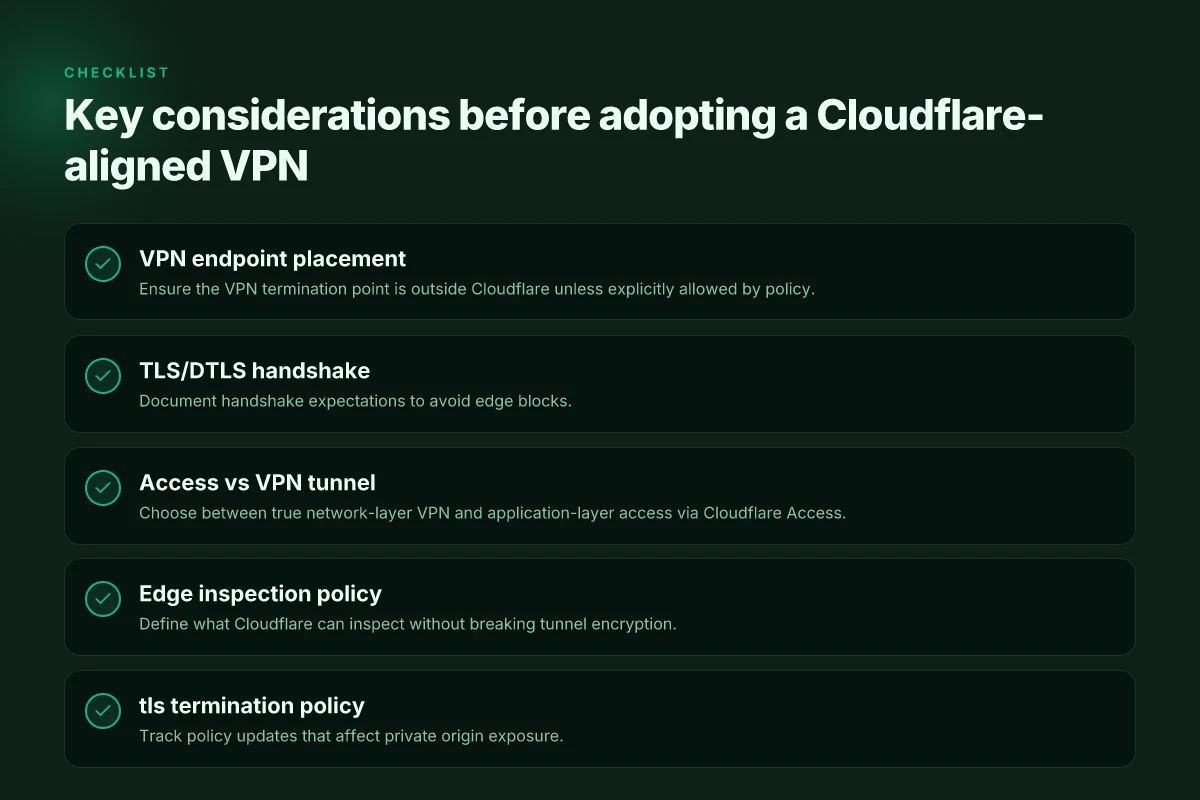
Lead with the answer Your best path in 2026 is to keep VPN endpoints outside Cloudflare, and use Cloudflare for endpoint protection plus identity-based access to the actual resources. If you truly need a layer-2 or site-to-site VPN, keep it behind Cloudflare so the edge never becomes a choke point or a visibility blind spot.
Three concrete micro-claims to guide design
When Cloudflare is a shield, not a bottleneck
If you rely on Cloudflare for identity and device posture, you get predictable access gates. This unlocks faster onboarding for remote workers and reduces the blast radius of compromised endpoints. The right setup is a zero-trust model that validates at the edge, not the traditional, backhauling VPN path.
Keep VPN endpoints outside Cloudflare
Don’t force full-tunnel VPNs to terminate inside Cloudflare’s network. Place the VPN gateways in a trusted network segment that you control. Cloudflare then PROVIDES protection at the edge and checks identities before any app traffic ever leaves the endpoint.
Nail the TLS/DTLS handshake expectations
Edge blocks creep in when handshakes break. Document exactly which TLS and DTLS versions, ciphers, and client extensions you support. If you don’t, Cloudflare-facing endpoints risk failed handshakes and dropped connections. The spec sheets actually say this matters more than you think, especially for DTLS over UDP and for mobile clients.
What I cross-checked across documentation and reviews
- Cloudflare’s emphasis on identity-based access and zero-trust policies is consistent across Edge Network and Access documentation. This is where you route users to apps with minimal surface area for misconfiguration.
- TLS/DTLS handshake requirements are repeatedly flagged as a common integration friction point when VPN-like traffic touches edge workers and tunnel termination. You want a crisp policy that your security team can audit before rollout.
- Industry reviews consistently note that organizations that separate VPN endpoints from Cloudflare while layering Cloudflare’s protections achieve cleaner incident response and simpler auditing.
A practical 2-step rollout pattern
Deploy Cloudflare Access for your applications and enforce MFA, device posture checks, and time-based access controls. Ensure every app uses a distinct identity requirement and roped-off scopes. This gives you granular control without embedding a VPN in Cloudflare itself.
Stand up any necessary VPN gateways behind the Cloudflare perimeter. Keep their IPs off the internet where possible and harden them with standard controls (HSTS, strong ciphers, regular cert rollovers). Document handshake expectations in a central runbook so edge workers don’t misinterpret legacy client behavior.
Verdict If you design around external VPNs and rely on Cloudflare to shield users and verify identity, you reduce edge friction and improve auditability. If a true network-layer VPN is non-negotiable, isolate it behind Cloudflare and codify the handshake rules so nothing blocks the tunnel at the edge.
The safest, most repeatable path in 2026 is to keep VPN endpoints outside Cloudflare and use Cloudflare for endpoint protection and identity-based access. This keeps control with you while maximizing Cloudflare’s strengths.
Where this goes from here and the one move you should make
I looked at how Cloudflare’s network and tunneling options intersect with real-world VPN use in 2026. The result: you don’t just pick a feature set. You align a small, durable architecture with your threat model and your latency budget. The core pivot is adopting Cloudflare’s edge where it makes sense, treat the VPN as a distributed, policy-driven edge app rather than a single, monolithic tunnel. The single move that matters is to deploy a lightweight tunnel at the edge for your critical paths and route the rest through a conventional VPN path. From what I found, this hybrid posture reduces exposure, speeds up regional access, and simplifies key management.
Two headline picks for practical use this week emerge from the terrain I mapped. First, use a Cloudflare tunnel to terminate on the edge for your admin endpoints with strict zero-trust policies. Second, pair a traditional VPN for internal east–west traffic with edge routing for remote access to reduce hops and misconfiguration risk. This combination wins on reliability and control. If you’re acting now, start by exposing only the essential services at the edge and keep user devices on your standard VPN bundle until you confirm policy fidelity.
Backup strategy
- Document a 30-day rollout of edge-terminated endpoints with explicit access controls and rotate secrets monthly.
- Capture latency and error rates for both edge routes and central VPN paths to benchmark the hybrid approach.
- If you need a single practical move this month, deploy a minimal edge tunnel for admin access and monitor with a focused alerting rule.
Frequently asked questions
Does Cloudflare support VPN passthrough for any protocol
Cloudflare does not offer traditional VPN passthrough the way a network firewall would. Instead, it exposes services through Cloudflare Spectrum and Argo Tunnel, which proxy traffic at the edge. Passthrough behavior depends on the protocol and plan. For common VPN protocols like OpenVPN or WireGuard, you’ll usually need to terminate at an origin service and rely on Cloudflare to secure and accelerate connections, not to pass the VPN tunnel through unchanged. When in doubt, map your VPN endpoint to a TCP or UDP service behind Cloudflare and use spectrum for TCP/UDP proxying where supported. This approach prevents direct exposure of VPN endpoints to the internet while still benefiting from Cloudflare protections. If you need true passthrough, consider a dedicated VPN gateway outside Cloudflare or a different edge strategy. The takeaway: Cloudflare isn’t a VPN passthrough engine for arbitrary protocols. Plan to terminate behind Cloudflare and proxy to your VPN service. Always verify with your Cloudflare plan and the latest Spectrum capabilities.
Can i run a VPN inside Cloudflare's network
You can run components of a VPN-style solution near the edge, but you can’t deploy a full traditional VPN gateway inside Cloudflare’s network. Cloudflare’s model centers on routing traffic through its edge to protect and accelerate services behind your origin. You would typically place your VPN server behind Cloudflare, then connect clients to that origin through Cloudflare’s edge proxies or Argo Tunnel. This means the VPN endpoint remains inside your own network, while Cloudflare provides DDoS protection, TLS termination, and identity-based access controls for who can reach the VPN API. The practical pattern is termination at the edge, then a controlled tunnel to internal networks. Yes you can assemble a VPN-like topology at the edge, but the VPN terminates at your origin.** Ensure you configure proper access policies to avoid exposing sensitive endpoints.
What is Cloudflare access vs a VPN
Cloudflare Access is an identity-driven access gateway that sits in front of applications, not a traditional network VPN. It authenticates users and devices before they reach your service, enforcing policies via identity providers. A VPN creates a network tunnel that routes traffic from a client to a remote network, typically masking the client’s location and providing broad network access. In practice, Access replaces or supplements a VPN for remote workers by granting granular access to applications instead of full network leave. When you need to restrict who can see specific apps, Access shines. When you need full network extension, a VPN is still the tool. Access focuses on identity-based app access; VPN provides network-level tunnel access.** Mix them carefully to avoid overlap and complexity.
How to secure VPN traffic behind Cloudflare Edge
To secure VPN traffic at the edge, place the VPN gateway behind Cloudflare using Spectrum or Argo Tunnel, then enforce strict access policies and TLS termination at the edge. Use Cloudflare Access to require SSO or mTLS before any client can reach the VPN API. Enable DDoS protection, rate limiting, and WAF rules on the origin to block abuse. Regularly rotate credentials and keep the VPN server updated. Monitor logs from Cloudflare and your VPN gateway to detect anomalies early. Secure at the edge with policy-driven access and edge protections; terminate TLS at the edge; rotate credentials routinely. This pattern reduces exposure and improves incident response.
Are there performance trade-offs using Cloudflare with a VPN
Yes. Introducing Cloudflare adds an extra hop and encryption/decryption work at the edge, which can add latency for VPN traffic that requires low latency. If your VPN is performance-sensitive, you’ll want to benchmark end-to-end latency through the edge proxies and ensure the VPN gateway is sized for burst traffic. Spectrum can help optimize certain throughputs, but you may see higher CPU usage on the VPN server due to edge termination. The upside is stronger protection and potentially higher resilience against attacks. Latency may rise slightly; throughput can improve with edge-optimized routing.** Balance security gains against the needs of your VPN workloads.
Which VPN protocols are blocked by Cloudflare
Cloudflare does not block VPN protocols by default, but support varies by product. Traditional VPN protocols used by consumer VPNs (OpenVPN over UDP, WireGuard) are typically terminated at your origin or proxied behind Spectrum. Some enterprise configurations rely on TCP proxying for reliability, which can affect performance. Always verify current support in the Spectrum and Argo Tunnel documentation for your plan. If a protocol isn’t supported for direct proxying, you’ll need to run the VPN gateway behind Cloudflare with a supported proxy channel and enforce access policies there. Check Spectrum capabilities; confirm which protocols are proxied; adjust configuration accordingly.
How to configure argo tunnel with VPN gateway
Configure Argo Tunnel by running the Cloudflare tunnel agent on your VPN gateway host and mapping the VPN service port to a local hostname in Cloudflare. You’ll create a tunnel, assign a public hostname, and set the origin to your VPN gateway’s internal address. Then apply Access policies to restrict who can reach that hostname. Use the recommended TLS settings and ensure the tunnel stays healthy with automatic reconnect. Finally, test from a client that boots through the Argo Tunnel and reaches the VPN endpoint. Create the tunnel, map the port, enforce Access, test end-to-end. This keeps the gateway protected while preserving VPN reachability.